
Mood Tracking and Your Brain: Why It Works and How to Start

Do you ever think to yourself, “Why am I like this?” after a day of random mood swings, snapping at someone you actually like, or feeling low for no clear reason? Our moods can feel unpredictable and chaotic, and sometimes seem completely disconnected from what is happening around us.
But here is the brilliant thing. They are not random.
Your brain is constantly forming patterns, rhythms, emotional responses, and physiological reactions throughout the day. We just rarely see the patterns because they live in our heads. Enter mood tracking.
Mood tracking is one of the simplest mental health tools you can use, and it is backed by genuinely interesting science. Whether you live with anxiety, ADHD, depression, burnout, or you are just trying to understand your emotions better, mood tracking gives you real information about your mind instead of guesswork.
And guesswork is exhausting.
So let us break it down. What exactly does mood tracking do in the brain? Why is it trending across TikTok and Reddit right now, and how can you use it in a way that actually sticks?

Why Mood Tracking Works: The Brain Science
Mood tracking is not just cute colouring pages or emoji faces in a journal. There are real neuropsychological benefits behind it.
Here is what the research tells us.
Mood Tracking Strengthens the Emotional Regulation System
Our brains have something called the limbic system, where emotional responses happen. When you track your mood regularly, you are helping your prefrontal cortex, the part of the brain responsible for logic and regulation, understand what is going on in the emotional part of your brain.
Think of it like this:
Your emotions fire first
Your prefrontal cortex makes sense of it
Mood tracking makes that process smoother and faster
This strengthens emotional regulation over time. Studies show that writing about emotions can reduce emotional intensity within just a few minutes. You are literally calming your brain by putting your feelings into words or colours.
It Builds Self-Awareness and Neuroplasticity
The more you observe your mood patterns, the easier it becomes for your brain to predict, understand and manage emotional responses.
It is neuroplasticity in action. Each time you reflect and label an emotion, you are strengthening pathways that help you understand yourself more quickly.
Over time, you go from:
“I feel awful and I do not know why,” to“I feel low today because I slept badly and overbooked myself.”
This shift alone can change your entire day.
Being able to use emotive language doesn't come easily to everyone, and often we get stuck in a loop of explaining our feelings as "tired" or "stressed".
Discovery Journal's Emotive Literacy expansion pack can help expand your emotive dictionary and improve your ability to communicate effectively!
Mood Tracking Reduces Anxiety
Anxiety thrives in the unknown. When you track your mood, the unknown becomes known.
You start seeing triggers like:
poor sleep
social overwhelm
certain people
certain places
hormones
food cycles
stress patterns
sensory overload
burnout buildup
Suddenly, you are not just anxious. You have context. And context reduces fear.
It Helps the Brain with Memory and Pattern Recognition
If you have ADHD and/or anxiety, you might look back on your week and say:
“I think I was fine but also awful and also stressed but also kind of ok.”
Memory is unreliable when emotions are involved.
Mood trackers give you data. Real data. Your brain can only work with the information it remembers. Mood tracking gives it something it can refer back to without relying on emotional memory.
How Mood Tracking Helps Your Mental Health Day to Day
This is where the magic actually happens. Mood tracking is not just about colouring in a chart. It helps with:
Better decision-making
You stop agreeing to things when your energy is low or your stress is high.
Managing relationships
You notice patterns like: “Every time I skip breakfast, I snap at people.”Or“After social events, I crash the next day.”
Reducing emotional overwhelm
Your brain feels calmer when feelings are documented instead of swirling.
Identifying early signs of burnout
Mood trackers often show burnout before you feel it.
Understanding your own cycles
People with anxiety, ADHD or hormonal fluctuations benefit hugely from seeing how moods change across a month.
Where to Start: A Friendly Guide for Forgetful or Busy Brains
If you think mood tracking sounds great, but you also know you will probably give up after two days, let us make this simple.
Tip 1: Keep It Stupidly Simple
If it takes more than one minute, you will not do it. Use a rating system, a colour, or a quick emoji.
Examples:
green, neutral, red
calm, fine, stressed, overwhelmed
a number from one to five
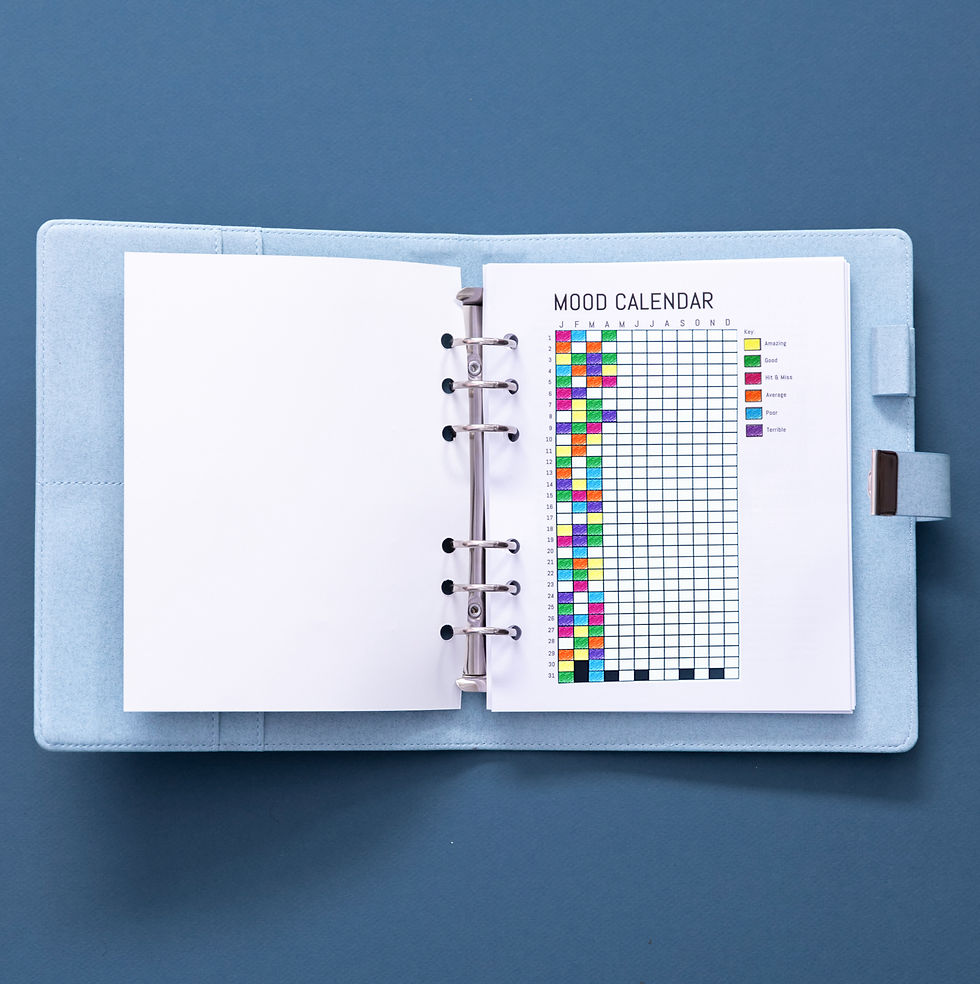
The Discovery Journal Mood Calendar does this perfectly because the daily mood box is tiny on purpose. You do not need to write an essay. You just need to mark the mood.
Tip 2: Track Only One or Two Things at First
People with ADHD especially benefit from starting tiny.
Try tracking:
mood
sleep
stress level
energy
Pick two. That is enough.
Tip 3: Place Your Tracker Somewhere You Cannot Ignore
If your journal lives at the bottom of your bag, it will die there.
Keep your mood tracking tool:
on your bedside table
next to your toothbrush
beside your kettle
on your desk
on top of your Discovery Journal
Seeing it means doing it.
Tip 4: Do It at the Same Time Every Day
Your brain loves consistency even if you do not.
Try:
first thing in the morning
before bed
after lunch
during your wind-down routine
Habit stacking works wonders. If you already make a morning coffee, add a one-minute mood check in.
Tip 5: Do Not Aim for Perfection
Missed a day? Missed five? It does not matter.
Mood tracking is not about being perfect. It is about learning your patterns over time.
Even half a month of tracking will show you something important.
The Best Tools for Mood Tracking (UK Recommendations)
Here are mental health-friendly tools to help you get started.
1. The Discovery Journal, Neurodiverse Edition

Price: £24.99 www.discoveryjournal.co.uk
If you want the most user-friendly mood tracker for anxiety, ADHD and neurodivergent thinking, this is the one.
Inside you get:
a yearly mood calendar
daily prompts that help you reflect without overthinking
grounding exercises
emotional literacy pages
guided self-awareness prompts
space for brain dumps
a design that actually works for forgetful brains
It is genuinely the easiest way to start mood tracking without overwhelming yourself.
2. Discovery Journal Printable Expansions
Perfect if you want more structure, or if you prefer digital downloads.
Recommended expansions for mood tracking:
Emotional Literacy Expansion Pack: Helps you put proper names to your feelings so mood tracking becomes accurate.
Reflection Expansion Pack: Helps you analyse your moods at the end of each week or month.
Headache and Symptom Log: Because many moods are tied to physical symptoms.
These are especially helpful for people managing anxiety, burnout or ADHD.
How to Read Your Mood Tracking Patterns
Once you have tracked your mood for a while, you can start reading the clues.
Here is what to look for:
1. Peaks and crashes
Are there days you always dip? Sunday nights? After work? Midweek?
Patterns show you what drains you.
2. Sleep correlations
Mood and sleep are best friends. If your mood tanks after every bad night, there is your culprit.
3. Hormonal patterns
People who menstruate often see dramatic mood cycles across the month. Mood tracking helps predict emotional dips so you can prepare.
4. Social patterns
Some people notice they crash after social events. Others crash when they spend too much time alone.
Mood tracking shows you your social sweet spot.
5. Lifestyle triggers
Look for patterns connected to:
screens late at night
sugar
caffeine
overthinking
conflict
lack of movement
noise sensitivity
work deadlines
Your brain is telling you something. Mood tracking helps you hear it.
Why Mood Tracking Helps Neurodivergent Brains Even More
ADHD, autism and anxiety all involve emotional regulation challenges. Mood tracking gives structure, predictability and self-awareness, which are hugely supportive.
Benefits for neurodivergent adults include:
making emotional patterns visible
reducing overwhelm
improving routine
identifying sensory triggers
improving communication with therapists
helping with medication reviews
Reducing shame by showing patterns are not personal failures
If emotional whiplash is a daily experience for you, mood tracking can feel like switching on a light in a messy room.
The Most Common Mistake People Make
Trying to track everything.
Please do not do that.
One or two mood metrics are enough. Otherwise, you will burn out on the process instead of learning from it.
Final Thoughts
Mood tracking is not just a journaling trend. It is a genuinely powerful mental health tool backed by psychology and neuroscience. It helps you regulate emotions, reduce anxiety, understand patterns, improve decision-making, and feel more grounded in your day-to-day life.


Comments