
The First Steps to Manage Anxiety

Anxiety can make life feel smaller and tougher.
Things that once felt manageable suddenly feel difficult. Decisions become harder, your thoughts become louder, and even simple tasks can start to feel overwhelming.
When anxiety builds over time, many people reach a point where they feel completely stuck.
Not necessarily because they do not want to feel better, but because they no longer know where to begin to make it stop, that is one of the most difficult parts about anxiety. It convinces you that everything needs fixing all at once and thrives off of immediacy.
But managing anxiety rarely starts with dramatic life changes. It usually starts much smaller than that.
Why Anxiety Makes You Feel Stuck
Anxiety overwhelms the nervous system.
When your brain perceives too much pressure, uncertainty, or emotional strain, it shifts into protection mode, regardless of whether there is a real threat or danger.
This affects:
concentration
motivation
emotional regulation
decision making
As a result, even small things can begin to feel mentally exhausting.
You may find yourself:
overthinking constantly
avoiding tasks
struggling to make decisions
feeling emotionally frozen
avoiding social situations
This is not laziness or weakness.
It is often the nervous system that has become overloaded.
The Pressure to “Fix Everything”
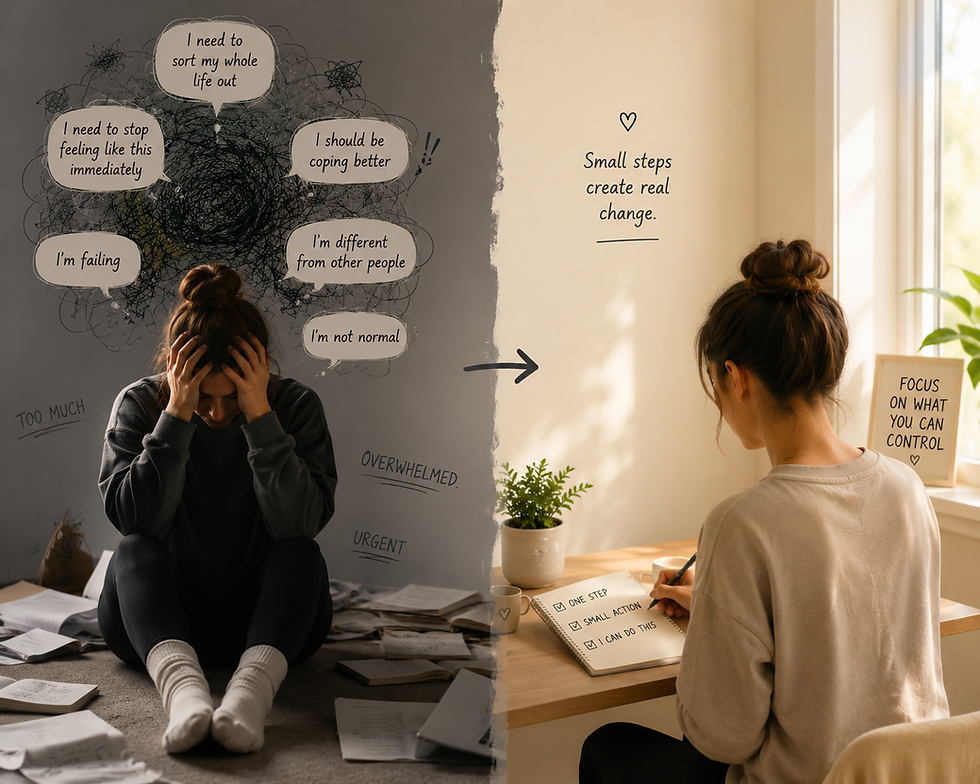
One of the reasons people stay stuck is that anxiety creates urgency.
Your brain wants immediate certainty and complete relief instantly.
This leads to thoughts like:
I need to sort my whole life out
I need to stop feeling like this immediately
I should be coping better
I'm failing
I'm different from other people
I'm not normal
But trying to solve everything at once often creates more anxiety. You can end up panicking.
The brain responds better to small, manageable actions than to intense pressure and "quick" results.
Manage Anxiety By Starting With What Your Body Needs First
When anxiety is high, people often focus entirely on thoughts.
But your body needs support too. It's the body that is reacting and makes the feeling worse.
Simple physical needs become incredibly important:
rest
hydration
food
movement
sleep
When these areas are neglected, anxiety often feels more intense because your nervous system has less capacity to cope. I know it sounds super simple, but often these aren't easy to achieve in the fast-paced world we live in. So you just need to do the best you can.
Calm Your Nervous System Before Solving Problems
A common mistake anxious people make is trying to think clearly while their nervous system is highly activated, but anxious brains struggle with perspective.
When your body feels unsafe, everything feels bigger, more urgent, and more emotionally intense. You'll find yourself searching for answers frantically in a brain that feels full of urgency and priority that doesn't exist.
This is why calming your nervous system first matters.
Things like:
slowing your breathing
grounding yourself physically
reducing stimulation
taking short pauses
Can help your brain shift out of survival mode enough to think more clearly. Once you make a bit of space, that's when the work can begin.
Mental Clutter Makes Anxiety Worse
Anxiety rarely exists in isolation.
When your brain is trying to hold onto everything internally, thoughts begin overlapping and repeating, becoming more frequent and over time making anxiety more permanent and regular.
This creates the feeling that your mind never fully rests.
Brain dumping and journaling are effective tools for reducing this mental pressure because they allow your thoughts to exist somewhere outside your head. Once they are on paper, a physical distance is created; you can start to think logically, notice changes, triggers and causes that could be contributing to the anxiety.
Using a structured journal or brain dump pad can help create immediate clarity by giving your brain permission to stop mentally carrying everything at once.
Why Writing Things Down Helps
When thoughts stay internal, they often become emotionally amplified.
Writing slows them down.
It allows your brain to:
process more clearly
separate worries from facts
release emotional tension
You do not need to write perfectly or deeply. You don't need to commit hours of your busy life or even write every day if you don't want to. The importance is in the data.
Finding patterns in the days and moments when your anxiety spikes and what you were doing, who you were with and how you felt can help you see the bigger picture and make changes to reduce the repetition of anxiety.

Guided prompts can make this process easier, especially on days when your thoughts feel difficult to untangle or you do not know where to start.
Stop Expecting Yourself to Function Perfectly
Many anxious people continue expecting themselves to operate as though nothing is wrong.
They push through exhaustion, overstimulation, and emotional overload while criticising themselves for struggling, but anxiety is draining, and you do need to accommodate it on days when it's difficult; that means rest.
Your nervous system is already using energy constantly.
Part of learning to manage anxiety is adjusting expectations with compassion instead of pressure.
Not lowering your worth, but recognising your current capacity honestly.
Rest is productive for anxiety recovery.
Connection Helps More Than Isolation
Anxiety often makes people withdraw inwardly.
You may stop replying to people, avoid talking about how you feel, or isolate yourself because everything feels mentally challenging. Avoiding social situations is a common "side effect" of anxiety because it feels "safer", but isolation often increases anxious thinking because your mind has no external perspective to balance it out.
Even small moments of connection can help:
honest conversations
reading relatable experiences
feeling understood
These moments remind your nervous system that you are not alone and create the connection your brain craves.
Recovery Often Feels Gradual
One of the most important things to understand is that managing anxiety is usually not linear.
Some days feel lighter. Others feel difficult again. That does not mean you are failing. Recovering from anxiety really is a marathon, not a sprint, and it takes time.
Progress often looks like:
understanding yourself better
having more anxiety-free moments
responding differently to stress
joining in on more activities and social events
These changes are real progress.

A Final Thought
The first steps to managing anxiety are rarely dramatic.
They are usually small moments where you stop fighting yourself long enough to create a little more space, calm, and understanding internally.
You do not need to solve your entire life today.
You need to begin supporting yourself differently than anxiety expects you to.
Simple tools like structured journals, guided prompts, and brain dump pages can help reduce overwhelm by creating clarity, emotional release, and a sense of structure when your thoughts feel difficult to manage alone. Discovery Journals are best for managing anxiety and are super easy to start.


Comments