
Why Do I Keep Giving Up on Journaling? 10 Reasons It Never Sticks
- Discovery Journal

- Aug 24
- 5 min read
You buy the journal.
It's beautiful.
You have intentions.
Possibly a new pen.
For three days you become the sort of person who journals.
Then Tuesday happens.
Two weeks later the journal is underneath a pile of paperwork, and you experience a tiny flash of guilt every time you see it.
If you keep giving up on journaling, the obvious conclusion is: "I'm just bad at sticking to things," but I'm not convinced that's usually the problem.
Quite often, you've simply chosen a form of journaling that requires far more time, effort or enthusiasm than you're realistically willing to give it.
Here are some of the biggest reasons journaling doesn't stick, and what you can do differently.
10 Reasons You Might Be Giving Up On Journalling:
1. You don't know what to write
This is probably the biggest one.
A blank page looks wonderfully freeing in theory, but in practice, it can be strangely intimidating. "Write whatever you're feeling." Okay.
What am I feeling?
How much do I need to write?
What counts?
Am I supposed to describe my whole day?
Do I need a meaningful conclusion?
Five minutes later, you've written the date beautifully and nothing else.
If this sounds familiar, you may not dislike journaling; you may dislike blank-page journaling.
Guided journals give you something to respond to instead.
A question.
A rating.
A checklist.
A short exercise.
Much easier.
2. You've accidentally turned journaling into homework
Some journals require an extraordinary level of commitment.
Morning reflection.
Evening reflection.
Goals.
Gratitude.
Habit tracking.
Three affirmations.
Five things you learned.
A quote.
A vision for tomorrow.
By the time you're finished, you're basically running a small administrative department dedicated to yourself.
A journaling habit has to fit into your actual life.
If you realistically have five minutes, choose something designed for five minutes.
Not something that assumes you'll wake up at 5:30 am and greet the sunrise with twenty pages of introspection.
3. You bought a dated journal
Dated journals create an incredibly specific form of guilt.
Miss one day? Fine. Miss four? Now four empty pages are reminding you that you have failed at stationery.
At some point, people start thinking: "Well, I've ruined it now."
You haven't, but psychologically, a run of blank dated pages can make restarting feel much harder.
That's why undated journals can be a much better choice if consistency isn't your strongest area. You use the next entry when you're ready.
No gaps.
No evidence.
The journal knows nothing.
4. You're expecting yourself to journal every day
You do not have to journal every day.
There.
Problem solved.
For some people, daily journaling works brilliantly.
For others, it becomes another thing on a list they're failing to complete.
Try:
three times a week
once a week
after difficult situations
when something significant happens
whenever you feel the need to check in
You can still build a useful record without maintaining a 365-day streak.
5. You're trying to write too much
A journal entry doesn't need to be an essay.
Sometimes: "Overwhelmed. Busy day. Too many people. Felt better after getting home."
contains plenty of useful information.
We often associate journaling with pages and pages of handwritten reflection because that's what journaling tends to look like in films.
Nobody in a film ticks three boxes, circles six out of ten and then goes to bed.
But they absolutely can.
6. The prompts don't suit you
Not all journaling prompts are created equally.
If every page asks: "What are you grateful for?" and gratitude exercises don't resonate with you, you're going to lose interest.
If every prompt wants a deeply thoughtful paragraph and you're tired, you're probably not going to answer it.
If you're sceptical of affirmations and the journal keeps telling you to write one, you may eventually want to throw it out of a window.
A good journal should suit how you process things.

7. You think missing a week means you've failed
This is probably the rule I'd most like to remove from journaling.
You can stop.
Then start again.
You don't need to backfill the missing entries.
You don't need to explain where you've been.
You don't need to ceremonially begin again on Monday.
Just continue. Journaling is a tool. Not Duolingo.
8. You're waiting for the right time
You imagine journaling happening: at a desk, in silence, with a cup of tea, possibly beside a candle.
Real journaling sometimes happens on the sofa while the television is on and you're trying to remember where you left your pen. It still works.
Make the routine easier rather than more aesthetic.
Keep the journal somewhere visible and leave a pen inside it.
Use it at roughly the same point in your routine.
Reduce the number of steps between "I should journal" and actually doing it.
9. You're trying to solve everything
A journal doesn't need to provide an answer every time.
You can write: "I don't know why this bothered me."
That is a legitimate observation.
You don't need to discover a trigger.
You don't need a breakthrough.
You don't need to finish every entry feeling transformed.
Sometimes you're just recording information.
That information may become useful later.
10. You're using the wrong type of journal
This is ultimately where a lot of abandoned journaling attempts lead.
There isn't one correct way to journal.
You can use:
blank notebooks
guided journals
workbooks
bullet journals
digital journals
trackers
printable pages
structured mental health journals
If one format doesn't work, try another.
How can a guided journal make journaling easier?
Guided journals remove the hardest question: What should I write?
Instead of generating your own topic, you respond to what is already there.
This is the approach used by Discovery Journal.
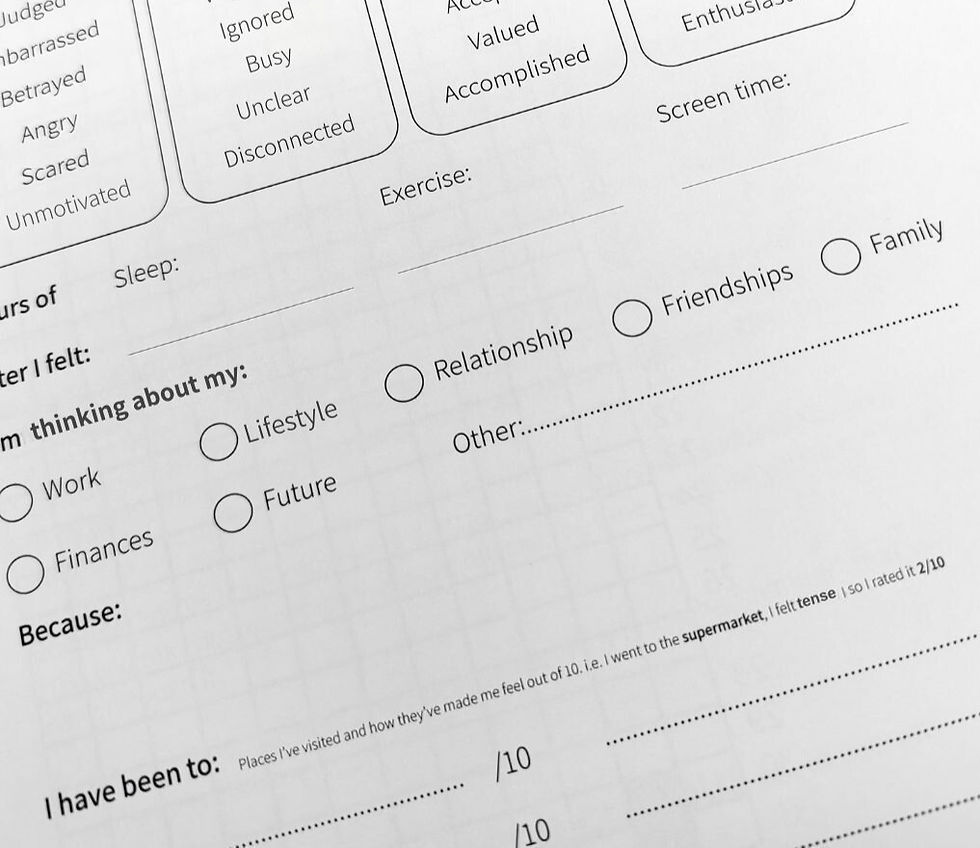
The journal contains repeatable structured entries using ratings, prompts, tick boxes and optional writing sections.
You don't have to fill a page.
You don't have to produce an eloquent reflection.
An entry is designed to take approximately 5–10 minutes.
And because it's undated, you can disappear for three weeks and return without being greeted by a graveyard of empty pages.
What if I hate writing?
Then don't choose a journal that requires lots of writing.
There are plenty of ways to record information.
Tick.
Circle.
Underline.
Rate.
Choose from options.
Write one sentence.
You can still reflect without enjoying long-form writing.
Discovery Journal was deliberately built around this idea, with structured elements doing much of the work and additional writing left optional.

How do you make journaling actually stick?
Make it smaller.
That's probably the best advice I can give.
Don't decide: "From tomorrow I'm journaling every evening for thirty minutes."
Try: "I'll do one five-minute entry this week."
Then another.
Build the habit from something so manageable that you can't make a convincing argument against doing it.
Can Discovery Journal help if you've given up on journaling before?

That's one of the groups I think the format works particularly well for.
Discovery Journal is a UK guided mental health journal designed to reduce blank-page pressure.
Its entries are structured, repeatable, undated and short.
There are Standard and Accessible layouts, and because the journal uses a refillable six-ring binder, you can add replacement inserts without replacing the whole thing.
It's not designed to make you write more.
It's designed to make it easier to start.
Stop trying to be good at journaling
This is possibly the whole point.
You don't need neat handwriting.
You don't need daily entries.
You don't need paragraphs.
You don't need to enjoy every prompt.
You don't need to complete the journal perfectly.
You just need a method that gives you something useful.
Because if you've repeatedly "failed" at journaling, maybe the answer isn't trying harder.
Maybe the journal needs to ask less of you.


Comments