
How to Start Journaling

So, you’ve bought a shiny new journal, and you’re ready to become the next introspective genius. There’s just one problem: the page is blank, and so is your mind.
If you’ve ever opened a journal with the intent to pour out your thoughts, only to sit staring at the page, wondering what on earth to write, you’re not alone. Starting a journal can feel overwhelming, especially when you put pressure on yourself to make it "meaningful" or "perfect."
But journaling isn’t about perfection. It’s about expression. And the best way to start? With prompts.
Why Journaling Matters (Even When You Don’t Know What to Say)
Journaling is a proven method to help reduce anxiety, improve mental clarity, and strengthen emotional resilience. But the hardest part is often just getting started. That’s why using guided prompts like those in the Discovery Journal's Unblocker Card Deck can be a game-changer.
How the Unblocker Cards Help
The Unblocker Card Deck is filled with powerful, deep-diving questions designed to get your inner dialogue flowing. Whether you’re trying to understand your emotions, explore your fears, or just make sense of your day, it’s a tool that supports you in moments of silence and confusion.
Ranging from easy to difficult, you can make the prompts into a game, choosing one at random or working your way up to the most thought-provoking ones.
These are not for the faint-hearted.
So next time the blank page stares back at you, remember: it doesn’t matter what you write, it matters that you start.
The Real Reason Starting Feels So Hard

Starting a journal is not difficult because you have nothing to say. It feels difficult because you are not used to listening to your own thoughts without distraction.
Most of the day is filled with input. Notifications, conversations, scrolling, noise. Your brain is constantly reacting, processing, and moving on.
But when you sit down with a blank page, all of that stops.
And suddenly, it is just you and your thoughts.
That can feel uncomfortable.
Not because something is wrong, but because your mind is finally being given space to catch up and process what we've done, where we've been, how we've felt.
Let Go of the Idea of “Doing It Right”
One of the biggest barriers to journaling is the belief that there is a right way to do it.
You might think:
It needs to sound insightful
It needs to be structured
It needs to lead somewhere
But journaling is not a performance. It is a process.
Some days it will be messy. Some days repetitive. Some days you will write the same thing over and over again.
That is not failure. That is the point.
Journaling works because it allows your thoughts to exist outside of your head, exactly as they are.
Start Smaller Than You Think
If sitting down to write a full page feels overwhelming, you are probably trying to do too much too quickly.
Instead, lower the barrier.
Start with:
One sentence
One thought
One question
That is enough.
For example:
“I feel overwhelmed, but I don’t know why”
“Today felt heavier than usual”
“I keep thinking about the same thing”
You do not need to have clarity before you start. Clarity often comes because you start.
Use Prompts When Your Mind Feels Blank

This is where prompts become incredibly useful.
Instead of asking yourself, “What should I write?” you are given a starting point. A direction. A way in.
Prompts remove the pressure of having to come up with something meaningful, and instead guide your thinking naturally.
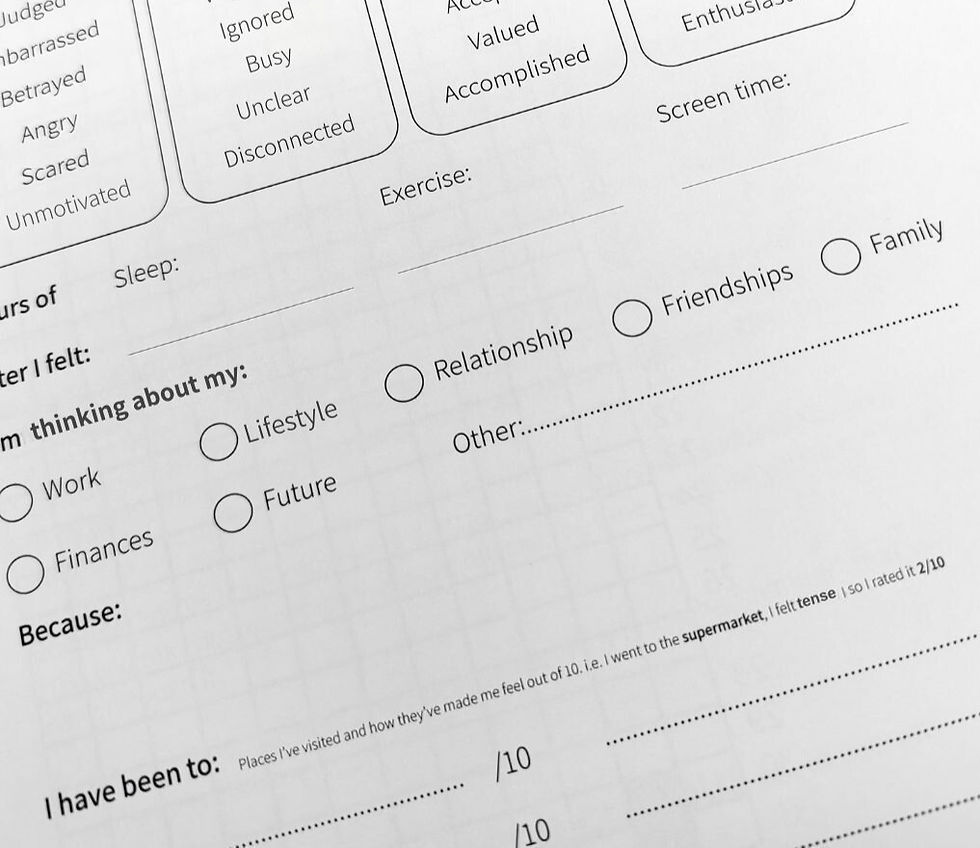
Tracking and guided journals come in really handy here. All the admin work is done for you; you simply need to find 5 minutes and fill it in. Over time, the tracking forms patterns, and you can clearly see the highs and lows, where anxiety is most prominent and where you feel most relaxed.
Sometimes all your mind needs is a question to respond to.
Different Ways to Start Journaling
Journaling does not have to look the same every day. In fact, it is often more helpful when it does not.
Here are a few simple approaches you can try:
1. The Brain Dump
Write everything that is on your mind, without structure or filtering.
This is especially helpful when you feel overwhelmed or mentally cluttered.
Just let it out.
2. The Reflection
At the end of the day, write about:
What stood out
What felt difficult
What did you notice about yourself
This helps you process your day instead of carrying it into the next one.
3. The Question
Start with a single question, like the ones in the Unblocker Card Deck, and answer it honestly.
You might be surprised how much comes out once you begin.
4. The Check In
Keep it simple:
How do I feel right now
Why might I feel this way
Even a few lines can create clarity.
What to Do When You Feel Stuck
There will be days when journaling feels difficult, even after you have started.
That is normal.
When that happens, try:
Writing “I don’t know what to write” until something else comes
Repeating the same thought until it changes
Switching to a prompt
Writing for a set time instead of a set amount
The key is to keep going, even when it feels slow or repetitive.
Because often, the most useful thoughts come after the initial resistance.
Journaling Is Not About Solving Everything
A common misconception is that journaling should lead to answers.
But often, its purpose is simply to help you understand what is happening.
You are not trying to fix every thought or resolve every feeling.
You are creating space.
And that space allows your mind to:
Process
organise
release
Over time, this leads to greater clarity and calm, even if it does not feel like it in the moment.
When Journaling Starts to Click
At some point, journaling begins to feel different.
You may notice:
Your thoughts feel clearer
You recognise patterns in how you think
You feel less overwhelmed
You are less reactive
This does not happen overnight. It builds gradually.
And often, you only notice it when you look back.


Comments